
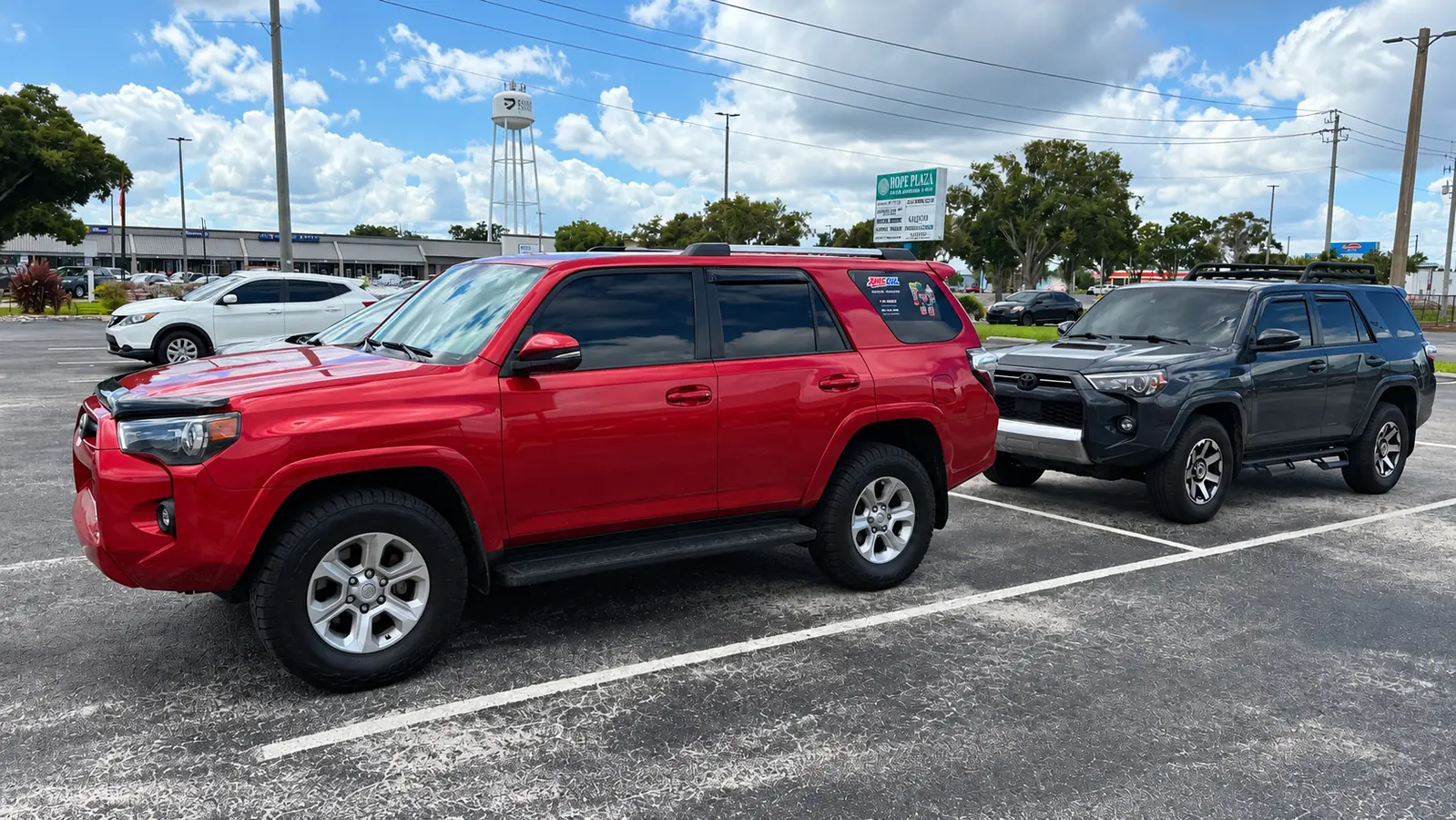
For a late-model U.S.-spec Toyota 4Runner with the 4.0L 1GR-FE, the simple answer is 0W-20.
That is Toyota’s published recommendation, and AMSOIL makes several very good 0W-20 oils that fit the application. Which one I would choose depends on the vehicle, how it is used and what the owner wants from the oil.
My own 2023 4Runner is a little different. I live in Florida. It sees heat, towing, extended idling and the kind of driving I consider severe service. I use AMSOIL Signature Series 5W-30 because I want the additional viscosity margin for my particular use.
That does not mean AMSOIL 0W-20 is inadequate. It is perfectly safe and appropriate for the engine, including a healthy higher-mileage engine. I did not switch to 5W-30 because 0W-20 failed. I made the decision based on the application.
Which North American Toyota Models Use the 1GR-FE?
In the United States and Canada, Toyota installed the 4.0L 1GR-FE V6 in several popular trucks and SUVs. This oil guide applies to 1GR-FE-equipped versions of the following models:
- Toyota 4Runner
- Toyota Tacoma
- Toyota FJ Cruiser
- Toyota Tundra
Not every model year or trim used the 1GR-FE, so verify the engine code and consult the owner’s manual for the exact vehicle before selecting oil. This page focuses on U.S. and Canadian applications. The Land Cruiser Prado appears later only because Toyota’s international viscosity chart provides useful documentation for the same engine family.
Start With the Factory Recommendation
For late-model U.S. 4Runners equipped with the 1GR-FE, Toyota calls for SAE 0W-20. If 0W-20 is unavailable, Toyota permits 5W-20 for that oil change and says to return to 0W-20 at the next change.
That is where the conversation should begin. I am not interested in telling everyone to use thicker oil simply because it sounds tougher. Toyota built the engine, and its published specification deserves to be taken seriously.
But a recommendation also has to account for how the vehicle is actually used. A 4Runner commuting to work in moderate weather is not doing the same job as one towing in Florida heat, idling for long periods or spending time off road.
The Same Engine Family Used Other Viscosities
The 1GR-FE was used around the world, and Toyota did not specify only one viscosity for every market and operating temperature. Even here in the U.S., Toyota’s specification for the 4.0L Tacoma and 4.0L Tundra is 5W-30.
A Toyota Land Cruiser Prado service-manual supplement for the 1GR-FE includes 5W-30, 10W-30, 15W-40 and 20W-50 on its ambient-temperature chart. That does not override the owner’s manual for a U.S.-spec 4Runner. It does show that the engine family was designed to operate on more than 0W-20 under the appropriate conditions.
You can view Toyota’s 1GR-FE Land Cruiser Prado lubrication chart here.
Market, model year, emissions calibration, climate and service all matter. This is why I do not make an oil recommendation from viscosity alone.
Why I Use 5W-30 in My 4Runner
My reason is straightforward: service application.
I deal with sustained Florida heat, towing, long periods of idling and high operating temperatures. I also plan to keep the vehicle for a long time. Under those conditions, I prefer the additional operating-temperature viscosity of a 5W-30.
This is my choice for my vehicle. It is not a blanket recommendation for every 1GR-FE. If your 4Runner is stock, operates normally and sees ordinary service, a quality AMSOIL 0W-20 remains an excellent choice.
Mileage Alone Does Not Decide the Viscosity
People often ask whether they should automatically switch to a thicker oil at 100,000 or 150,000 miles. My answer is no—not automatically.
I want to know whether the engine consumes oil, leaks, has low oil pressure or shows any mechanical problem. I also want to know the climate, driving pattern, towing load, idle time and maintenance history.
A healthy higher-mileage 1GR-FE can continue using 0W-20. If the engine has a mechanical issue, thicker oil should not be used as a substitute for finding out what is wrong.
Which AMSOIL Oil Should You Use?
AMSOIL gives you options. I like Signature Series, but I am not going to pretend it is the only good oil the company makes. OE, XL, High-Mileage and even the Synthetic-Blend line all have a place.
AMSOIL Synthetic-Blend


This is the budget-minded choice for routine maintenance. It provides dependable everyday protection for someone following the vehicle manufacturer’s normal interval. AMSOIL does not currently offer it as one of the vehicle-specific oil-change kits, so the oil and filter are ordered separately.
AMSOIL OE 100% Synthetic


OE is not a cheap or second-rate oil. It is a very good full synthetic designed for drivers who plan to follow the factory oil-change interval or oil-life monitor. This is the AMSOIL line that goes head-to-head with the mainstream full synthetics most people recognize from auto-parts and big-box stores.
AMSOIL High-Mileage 100% Synthetic


Suppose you bought a used 4Runner with 120,000 miles and do not know its full service history. High-Mileage deserves a serious look. It is designed for vehicles with more than 75,000 miles and uses boosted detergency to help fight deposits along with seal conditioners intended to help reduce leaks and oil consumption.
High-Mileage is about the needs of an older engine. I do not present it as an extended-drain oil.
AMSOIL Extended-Life (XL) 100% Synthetic


AMSOIL Extended-Life—often still called XL—steps up the protection and adds longer service capability. It is a good fit for the owner who wants more performance margin than a factory-interval oil and wants the potential to reduce the number of oil changes over the vehicle’s life.
AMSOIL Signature Series 100% Synthetic


Signature Series is AMSOIL’s top-tier gasoline motor oil and what I consider the gold standard of motor-oil protection. It is designed for the owner who wants the best oil AMSOIL makes—not simply an oil that meets the minimum requirement.
It offers an even greater performance margin and longer potential drain intervals than XL. It is engineered to resist oxidation, maintain viscosity, control deposits and protect against wear through demanding conditions and extended service.
This is the line I look to when maximum protection is the priority: severe heat, towing, extended idling, high annual mileage, long-term ownership or simply wanting the highest level of protection AMSOIL offers.
That does not mean every driver needs Signature Series. The right oil is the one that fits the engine, the service and the owner’s maintenance plan. I will cover these product lines in greater detail in a separate guide.
Save Up to 25% on AMSOIL
Join the Preferred Customer program for discounted pricing on eligible AMSOIL products.
Extended Intervals Require the Right Oil, Filter and Data
An oil analysis does not magically turn ordinary oil into an extended-drain oil. Extended service starts with an oil engineered and recommended for longer intervals. In this lineup, that discussion belongs under XL and Signature Series—not Synthetic-Blend, OE or High-Mileage.
The filter matters too. The oil and filter have to be treated as a system. A premium extended-service oil paired with a filter that lacks the efficiency, capacity or rated service life for the interval can undermine the entire plan.
If the oil interval exceeds the filter manufacturer’s published limit, the filter has to be changed at its limit and the oil level restored. Oil analysis does not extend a filter beyond its rated service life.
Then we use the laboratory. Run the oil to the current change point and take a representative sample. The lab evaluates the oil condition, viscosity, wear metals, fuel dilution, contamination and other indicators. If the laboratory recommends continued service, the next sample or change point can be planned from that guidance.
One report gives you a snapshot. Several reports taken consistently build the trend. For many personal vehicles, it may take about a year to build a useful data set because the value comes from comparing multiple samples under real operating conditions.
We can help with this. We can supply the Oil Analyzers test kits and the oil-analysis sampling pump, help establish the sampling schedule and review the laboratory reports with you. The goal is not to guess at a big mileage number. The goal is to let the data show what is happening in your engine.
Where the Lifetime Savings Can Come From
With XL or Signature Series, properly managed extended service can reduce the number of oil changes over the life of the vehicle. That can mean less oil purchased, fewer filters, less waste oil and less time spent performing maintenance.
The other side of the equation is protection. Oil engineered to resist wear, oxidation, viscosity loss and deposits is intended to help preserve the engine over the long haul. Avoiding wear and keeping an engine clean can matter far more financially than saving a few dollars on the cheapest oil available.
I do not promise that any oil will prevent every repair or make an engine last forever. What I can do is match the product to the application, use an appropriate filter and use laboratory data when we are verifying an extended interval.
4Runner and FJ Cruiser 1GR-FE Oil Capacity, Filter and Torque
| Engine | Toyota 4.0L V6 1GR-FE |
|---|---|
| Oil capacity with filter | Approximately 6.6 U.S. quarts |
| AMSOIL oil filter | EA15K49 |
| Drain-plug torque | 30 lb-ft |
| Factory viscosity for late-model U.S. 4Runner | SAE 0W-20 |
Tacoma and Tundra owners: your specs differ. The 4.0L Tacoma takes about 5.5 U.S. quarts with filter (4.8 quarts on the RWD base truck), uses 5W-30 and the AMSOIL EA15K51 filter. The 4.0L Tundra takes about 4.8 quarts with filter and uses 5W-30. Verify the specifications for the exact year, model and configuration before servicing any vehicle. After filling, run the engine, inspect for leaks, shut it down, allow the oil to settle and confirm the level on the dipstick.
Ready to Protect Your 1GR-FE?
Choose your exact Toyota year and model, compare the AMSOIL options and build a complete oil-change kit with the correct oil and filter. Preferred Customers save up to 25%, and qualifying orders ship free right to your door.
Select your vehicle in the official AMSOIL lookup to confirm the correct products and capacity.
Toyota 1GR-FE Oil FAQ
What oil does a late-model Toyota 4Runner with the 1GR-FE use?
For a late-model U.S.-spec Toyota 4Runner with the 4.0L 1GR-FE, start with SAE 0W-20. Always verify the owner’s manual for the exact model year and application.
Can a Toyota 1GR-FE use 5W-30?
Yes. Toyota’s U.S. specification for the 4.0L Tacoma and 4.0L Tundra is 5W-30, and Toyota specified 5W-30 for the 1GR-FE in other markets and operating-temperature ranges. For a late-model U.S. 4Runner, the owner’s-manual recommendation is still 0W-20. I use AMSOIL Signature Series 5W-30 in my 2023 4Runner because of Florida heat, towing and severe service; a quality AMSOIL 0W-20 remains the correct choice for many owners.
Should a high-mileage 1GR-FE automatically switch to thicker oil?
No. A healthy higher-mileage engine can continue using the specified viscosity. Oil consumption, leaks, oil pressure, climate, towing, idle time and service history matter more than the odometer alone.
How much oil does the Toyota 1GR-FE hold?
A late-model 4Runner or FJ Cruiser 1GR-FE takes approximately 6.6 U.S. quarts with the filter. The 4.0L Tacoma takes about 5.5 quarts (4.8 on the RWD base truck), and the 4.0L Tundra about 4.8 quarts. Confirm the capacity for the exact year and configuration, then verify the final level on the dipstick.
How do you verify an extended oil-change interval?
Start with an oil engineered and recommended for extended service, pair it with a filter rated for the planned interval and use laboratory oil analysis to verify how the oil is performing in that specific engine and application. One sample is a snapshot; repeated samples establish the useful trend.
The Bottom Line
For most late-model U.S. 4Runners with the 1GR-FE, 0W-20 is the correct place to start. AMSOIL offers several good ways to get there, from an economical Synthetic-Blend through OE, High-Mileage, XL and Signature Series.
My personal use of Signature Series 5W-30 comes down to Florida heat and severe service. It is not proof that 0W-20 is wrong, and it is not a recommendation that every 4Runner owner copy what I do.
Start with the factory specification. Look honestly at the application. Choose the level of protection that fits the vehicle and the owner. If extended service is the goal, use an oil designed for it, use the right filter and let the laboratory data guide the interval.
Art Bourget is an authorized AMSOIL dealer with more than three decades of experience in the automotive, performance and fleet industries. FullSyntheticOil.com is operated by Red White and Gears LLC. Product recommendations are provided independently; purchases are fulfilled and paid through AMSOIL.
Last reviewed: September 2026. Always consult the owner’s manual and current product information for your exact vehicle and application.